SHOE FLOWER
The word hibiscus derived from the ancient Greek
hibiskos, the name for the plant known as marsh mallow or white mallow.
Hibiscus is a genus of flowering plants in the mallow family, Malvaceae. It is
quite large, containing more than 200 species that are native to
warm-temperate, subtropical and tropical regions throughout the world. By
recent count about 220 species of annuals, perennials, herbs, shrubs and trees
belong to the genus Hibiscus. This is a genus of great diversity. Some hibiscuses
originated in tropical regions of the world, other in temperate regions. Some
are herbaceous, others woody. In habit they range from low-growing, spreading,
types to upright, woody forms that reach up to six meter tall.
The flowers of most species open early in the
morning and begin to droop and wilt by late afternoon. Most last only one day,
but a few varieties have flowers that last two days or more. While most
hibiscus flowers are odorless, a few are modestly fragrant. The hibiscus flower
can be found in many colors and sizes, which will determine the specific type
of flower. According to research information there are more than a thousand
color options, but no blue or black in the true sense. The sizes will vary from
2 inch blooms to 12 inch blooms.
It is a beautiful plant. But apart from being
beautiful, a hibiscus plant and flower is immensely useful too. Nobody knows
whether the hibiscus really is a native of China as its latin name, Hibiscus
rosa-sinensis, (rosa-sinensis = Chinese Rose) suggests or not. Many believe, it
comes from India. This large shrub or small tree grows to 15 feet high. The
toothed leaves are arranged alternately and vary a lot, but tend to be large,
dark green, and shiny. This plant has a coarse texture and may be upright or
broad and spreading. It is often many-stemmed. Flowers are glorious and huge at
their best -- up to 6" in diameter -- and occur in many colors. Most are
flared and have a bell shape and may be single or double, smooth or scalloped.
They have a long central tube with stamens and pistils at the tip.
Commercial use.
Hibiscus cannabinus, or kenaf, is not a new crop
plant. It was first planted and grown in Sub-Saharan Africa more than 6000
years ago and has long been commercially growing in India, Africa, Asia, the
Middle East, and more recently in Latin America. It has considerable potential
as a crop in countries that fall within its tropical to subtropical
requirements and could be grown in the southern United States as an
environmentally sound alternative to soft and hard woods for paper production.
Since it is a hair stimulator, it's a popular constituent in many of the
popular brands of shampoos and conditioners and its fibers are used to make
grass skirts and wigs in Polynesia.
Edibility.
Many plants of the Malvaceae, including hibiscuses,
have been eaten as potherbs since early times, and modern researchers have
discovered that some species are very rich in vitamins. Of course, extreme care
should always be taken when introducing anything new to your diet. Even the
comparatively innocuous genus hibiscus has species that may irritate some
people. The diuretic action of some hibiscuses, for example, might cause kidney
problems in certain individuals. That said, if all necessary precautions are
taken, you should be able to enjoy edible hibiscuses without problems.
Hibiscus tea or herbal hibiscus tea is a popular hot
beverage in many countries. Different color variants of the hibiscus flower are
used for making jams also.
Sorrel is a very popular cold beverage that is
consumed during the Christmas time. It is often drunk with hard drinks like rum
and wine.
Due to the presence of Vitamin C in it, hibiscus
extract is also used for adding a tangy flavor to certain foods and drinks.
Red-blue color of the hibiscus is a very popular
food color that is derived from the dried hibiscus petals. The dried petals are
then boiled in water to derive the red color extract from the hibiscus flower.
It is used as a garnish and a delicious vegetable in
Mexican region.
Medicinal Value.
It has medicinal properties that are helpful in
treating dandruff, hemorrhoids and blood pressure irregularities. Loss of
appetite, indigestion, and respiration problems can also be treated by hibiscus
extracts. Use caution and consult a physician before using any hibiscus
medicinally or for other health purposes. Pregnant women should avoid Hibiscus
species altogether, as some appear to have abortive effects.
Previously
these plants were found as an ornamental plant on each and every houses of Kerala.
But today I think we lose this plant also along with our tradition. This
article is about use of certain species of shoe flowers that we see commonly in
India and abroad.
1) Hibiscus
acetosella (Cranberry hibiscus)

Cranberry hibiscus (Hibiscus acetosella)
is an angiosperm of the genus Hibiscus L. or rosemallow. The word acetosella is
of Latin origin and is derived from an old name for sorrel (Oxalis) which comes
from the sour taste experienced when eating the young leaves of the plant.
Hibiscus acetosella is also known colloquially as African rosemallow, false
roselle, maroon mallow, cranberry hibiscus, red leaved hibiscus, and red shield
hibiscus. It is one of the approximately 200–300 species that are seen in
sub-tropic and tropic regions. This ornamental is usually found in abandoned
fields or open areas, marshes, and forest clearings. Cranberry hibiscus is a
member of a perennial group known as hardy hibiscus. In contrast to the
tropical hibiscus, hardy hibiscus can tolerate colder conditions, are more
vigorous, longer lasting, and have larger flowers. In colder climates, Hibiscus
acetosella is easily an annual, but is often regarded as a perennial to zone
8–11. During one season, the plant can grow 90–170 cm (3–5 feet) tall and 75 cm
(30 inches) wide as a shrub-subshrub.
EDIBLE USE
Cranberry hibiscus is mostly known for its slightly sour or pleasantly
tart young leaves which are commonly used as a vegetable, either raw or cooked.
In South America, the leaves are used sparingly in salads and stir-fries.
Leaves are eaten in small quantities due to acid content and because they are
mucilaginous. Cranberry hibiscus leaves also contribute to the décor of various
dishes since they retain their color after being cooked.
Flowers are used to make teas or
other drinks where they contribute color rather than taste. In Central America
the flowers are combined with ice, sugar, lemon, or lime juice and water to
make a purple lemonade.
The root is edible however thought
of as fibrous and distasteful. Contrary to similar species such as the Hibiscus
sabdariffa, the calyx or sepals of Hibiscus acetosella is non-fleshy and not
eaten. In Angola a tea made from the leaves of cranberry hibiscus are used as a
post-fever tonic and to treat anemia. The plant is also utilized to treat
myalgias by crushing leaves into cold water to bathe children. The plant is
thought to contain polyphenols, a compound that combats reactive nitrogen and
oxygen species or RNOS that are generated as a biproduct from the body`s
inflammatory response. Therefore it is commonly used to treat inflammatory
diseases.
2) Hibiscus
aculeatus (Comfort root)

Comfort Root is also known as
Pinelands Hibiscus or Cut-leaf Hibiscus.
Plant is an upright, hairy
perennial. Preferred habitat is savannas, roadsides, ditches and dense pine
woods. Distribution is throughout the Escambia region.
Leaves are long-stalked, palmately
lobed with three or more veins arising from the stalk at the center of its
base; toothed and squared.
The flower are solitary on a long
stalk; yellowish white to creamy or snowy white. Flowers occur in the summer.
Fruit is a capsule (resembles a
small pod of okra); bristly, with short barbs.
A pollinator, while making its
rounds in search of nectar, touches the flower stigma with pollen from another
flower. In so doing it loses most of its
pollen load. To get at the nectar
within it must burrow deeper into the blossom, thus picking up a new load of
pollen - repeating the process at the next flower, the little insect has
unwittingly achieved cross-pollination without much to show for a day's work.
Medicinal use: The roots contain mucilage and have
been used medicinally as a soothing agent, hence the common name Comfortroot.
Its latin name aculeatus means 'prickly' in reference to the sandpaper-like
feel of the stems and leaves. Found naturally in sandy soil; bogs, moist
pinelands, savannas, ditches and coastal plains from Florida to Louisiana,
north to North Carolina.
3)Hibiscus rosa sinensis ( snow queen
hibiscus)


The Snow Queen hibiscus is a large shrub with red
flowers set against lovely variegated green, white and pink leaves. Large
serrated edged flowers are red and are trumpeted shaped. The are often held in
a semi-pendulous manner and when looked from the front, have a star shape. The
floral tube is outrageously long and is covered in yellow stamens. This plant
grows dense and large. The variegated leaves change color with age, and when
planted in more sun, often hold on to the red and pink colors better.
Tropical hibiscus is heat tolerant
and prefers neutral to acidic, well-drained soil and full sun. A staple of both
tropical and temperate landscapes, these vibrantly blooming plants can be grown
in mixed borders, or in large containers that can be moved indoors to
overwinter if necessary. 'Snow Queen' will be showiest around other plants that
are dark green or dark red with larger, bolder and non-variegated leaves.
Uses: flowers, roots and leaves,
are anodyne and emmenagogue. They regulate menstruation and stimulate blood
circulation. Flower extract has been traditionally used for liver disorders,
high blood pressure and as an aphrodisiac. Young leaves and flowers are used in
case of headache. Decoction of leaves, root and fruits are helpful in
treatments of arthritis, boils and coughs, and
the fruit is used externally in
cases of sprains, wounds and ulcers. Hibiscus tea is rich in Vitamin C.
4) Hibiscus
Archeri

Hibiscus Archeri is an old hybrid
between Hibiscus rosa sinensis and Hibiscus schizopetalus. The blood-crimson
flowers of this plant render it a most striking ornament just now in the
greenhouse; it would prove undoubtedly so were the blossoms produced with
greater freedom. The rich shade of colour and the pretty fringed form of the
flowers alike assist in rendering it most attractive. hibiscus are called
"kembang sepatu", which literally means 'flower of shoes' ―perhaps in
reference to the fact that hibiscus flowers were used to shine shoes in places
like India) The growth habit is very attractive; the plant grows vigorously
high and then at the end of the bending branches are the elegant flowers ―large
and bright red, with a long flowering season.
Uses: Ornamental for appearance, the foliage and
flowers, the latter often worn as an ornament of hair.
5) Hibiscus arnottianus
( white rose mallow)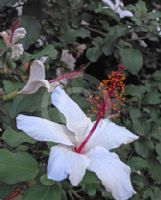
Hibiscus arnottianus is a
shrub or small tree generally 15 to 20 feet in height though a few individuals
will grow to 30 feet tall. These specimens can be up to 20 feet in diameter.
Individual plants vary in appearance from open and airy to compact. The leaves
are oval with a smooth upper surface and smooth or slightly toothed edges. The
leaves are 4 to 6 inches long and often have red veins and stems.
The single white flowers are
pinwheel shaped, up to 4 inches across, and borne at the ends of the branches.
The staminal column is pink to red (except in subspecies immaculatus which has
a white column). The flowers may be slightly pink or may age to pale pink, and
are slightly fragrant. In cultivation, Hibiscus arnottianus blooms almost
continuously.
They contain three sub species
a) Hibiscus
immaculates (white rose mallow)

is
native to Moloka'i and has a white staminal column and leaves with rounded
teeth. The leaves are 4-10cm long and often have red veins and stems. The
faintly fragrant flowers have white petals 8-11cm long. The flowers may be
slightly pink or may age to pale pink. Hibiscus arnottianus ssp. immaculatus is
found in only in four populations on Moloka'i. It is the rarest of all and is
listed as an endangered species.
Uses:
The
flower buds of the white rose mallow were used as a mild laxative by the early
Hawaiians. Also, the fibers of this tree were used for cordage
b) HIBISCUS
PUNALUUENSIS (PUNALUU ROSEMALLOW):

The
Punaluu Rosemallow is also native to O'ahu. This is the most common of the
three subspecies. Its a robust plant with leaves up to 25cm long and comes from
the Ko'olau Mountains at elevations of 650 to 2200 feet.
5) Hibiscus biseptus ( Arizona rosemallow)
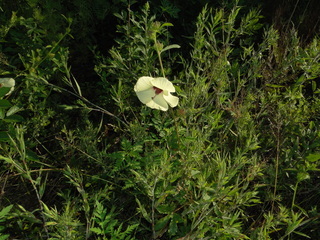
Arizona rose-mallow is a perennial shrub that is
native to southern Arizona, New Mexico, and northern Mexico.
Although not common in Arizona, its natural habitats
are canyons and dry hillsides at 3,000 to 4,500 feet.
Like its relative Hibiscus coulteri, it has silky
yellow flowers that are produced throughout the summer and fall,
but flowers are much larger than Hibiscus coulteri,
measuring at least 3 inches across. They are semi-deciduous
during the cooler months and the palmate leaves will
change to a bright red color signaling the arrival of fall.
Prefers well-draining, rocky soils or soils that
have been amended with organic compost. Plant with other
summer and fall blooming plants such as Anisacanthus
quadrifidus, Asclepias subulata, or Gaura lindheimeris
6) Hibiscus calyphyllus (lemonyellow rosemallow)
 Hibiscus calyphyllus is a dense,
perennial, rounded shrub; up to 3 m high; the leaves are large, up to 50 mm in
diameter, light green, soft and velvety; the flowers are lemon-yellow, large,
up to 100 mm in diameter, with a deep red to blackish centre; the fruit is a
papery capsule that splits open to reveal hairy to hairless seeds. It is fairly
fast growing and will flower repeatedly, the flowers lasting for a reasonable
amount of time. Flowering time: all year round, but mainly from January to
April.
Hibiscus calyphyllus is a dense,
perennial, rounded shrub; up to 3 m high; the leaves are large, up to 50 mm in
diameter, light green, soft and velvety; the flowers are lemon-yellow, large,
up to 100 mm in diameter, with a deep red to blackish centre; the fruit is a
papery capsule that splits open to reveal hairy to hairless seeds. It is fairly
fast growing and will flower repeatedly, the flowers lasting for a reasonable
amount of time. Flowering time: all year round, but mainly from January to
April.
Use: In addition to being a popular
garden subject, Hibiscus calyphyllus is apparently also a source of food in the
Okavango Delta, where the flowers are cooked and eaten when there is a shortage
of food.
7) Hibiscus canabinus (brown Indian hemp)

Kenaf [etymology: Persian],[1]
Hibiscus cannabinus, is a plant in the Malvaceae family. Hibiscus cannabinus is
in the genus Hibiscus and is probably native to southern Asia, though its exact
natural origin is unknown. The name also applies to the fibre obtained from this
plant. Kenaf is one of the allied fibres of jute and shows similar
characteristics.
Use: Leaves used as purgative.
- In Gambia, infusion of leaves
used for coughs.
- Flowers used for biliousness and
constipation.
- Seeds oil used externally for pains
and bruises; and internally as an aphrodisiac.
- In India and Africa, used for
blood and throat disorders, bilious conditions, fever and puerperium.
8) hibiscus clayi (red kaur rose
mellow)
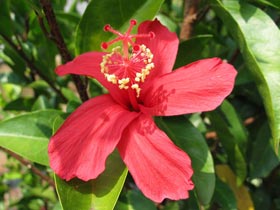 An endangered tree that is endemic
to dry forests in the mountains on the island of Kaua'i. Only one naturally
occurring population of four individual plants remain intact. However, habitat
protection efforts and propagation of plants in botanical gardens are slowly
increasing the number of plants found in forest reserves and gardens.
An endangered tree that is endemic
to dry forests in the mountains on the island of Kaua'i. Only one naturally
occurring population of four individual plants remain intact. However, habitat
protection efforts and propagation of plants in botanical gardens are slowly
increasing the number of plants found in forest reserves and gardens.
9) Hibiscus clypeatus (congo mahoe)

The Congo mahoe develops like a
tree. Congo mahoe isn't an evergreen; during the summer it assumes a red
colouring; the adult species are large in size and reach 17 m in height. The
Congo mahoe develops growing in height, and develops a bare stem, creating a
thick crown.
10)hibiscus coccineus ( scarlet rose mallow)
 Hibiscus coccineus or scarlet rose
mallow, is a hardy Hibiscus species that looks much like Cannabis sativa
(marijuana). It is also known as brilliant hibiscus, scarlet hibiscus and
scarlet rose mallow.
Hibiscus coccineus or scarlet rose
mallow, is a hardy Hibiscus species that looks much like Cannabis sativa
(marijuana). It is also known as brilliant hibiscus, scarlet hibiscus and
scarlet rose mallow.
The plant is native to a marsh-like
habitat. It dies back during the winter and grows from 7-10'. In addition to
the scarlet flowering variety, a white flowering variety is also known as the
white Texas star or lone star hibiscus.
11)
 Perennial subshrub to 4'. Flowers
to 2" wide and are yellowish-white with reddish area at the base. Flowers
have 5 rounded petals forming a cup-like structure. Stamens are joined at the
base and flare out along the style which is topped with 5 reddish-purple stigma
lobes. Leaves are simple, toothed, and lobed to 1" long (basal leaves are
not lobed and are up to 1.5" long. Malvaceae (Mallow) Family.
Perennial subshrub to 4'. Flowers
to 2" wide and are yellowish-white with reddish area at the base. Flowers
have 5 rounded petals forming a cup-like structure. Stamens are joined at the
base and flare out along the style which is topped with 5 reddish-purple stigma
lobes. Leaves are simple, toothed, and lobed to 1" long (basal leaves are
not lobed and are up to 1.5" long. Malvaceae (Mallow) Family.
NATURAL HISTORY: Flowers may bloom
throughout year.
12) Hibiscus brackenridgi (Ma'o Hau
Hele )
 The flowers are 4 to 6 inches (10
to 15 cm) wide and have 5 crinkled, egg-shaped petals, a yellow staminal column
with a small, 5-lobed style and yellow to reddish anthers all along the length
of the column, and 7 to 11 hairy, green, linear to awl-shaped bracteoles below
the flowers. The flowers either have a solid red center or just have small
splotches of red at the base of each petal. The flowers are followed by beaked
seed capsules. The leaves are green, alternate, toothed, finely hairy to almost
hairless above, and fuzzy below. The mid-plant leaves are either egg-shaped or
have 3 to 7 palmate lobes like a maple leaf. The upper leaves are more
lanceolate to oblanceolate in shape. The branches are smooth to wrinkled and
spineless or covered with pustule-like spines.
The flowers are 4 to 6 inches (10
to 15 cm) wide and have 5 crinkled, egg-shaped petals, a yellow staminal column
with a small, 5-lobed style and yellow to reddish anthers all along the length
of the column, and 7 to 11 hairy, green, linear to awl-shaped bracteoles below
the flowers. The flowers either have a solid red center or just have small
splotches of red at the base of each petal. The flowers are followed by beaked
seed capsules. The leaves are green, alternate, toothed, finely hairy to almost
hairless above, and fuzzy below. The mid-plant leaves are either egg-shaped or
have 3 to 7 palmate lobes like a maple leaf. The upper leaves are more
lanceolate to oblanceolate in shape. The branches are smooth to wrinkled and
spineless or covered with pustule-like spines.
This lovely native yellow hibiscus
is the official Hawaii state flower. It grows in dry forests and shrublands at
lower elevations. Different subspecies grow on different Hawaiian islands and
vary in appearance.
The yellow-flowered form of the
much more common Chinese Hibiscus (Hibiscus rosa-sinensis) is similar, but it
has non-lobed leaves and the central staminal column of its flowers has a
larger 5-lobed style and anthers only near the tip of the column.
Special Characteristics
Legal Status – Protected Plant
(Endangered). Although few plants remain in the wild due to overgrazing by
non-native animals, competition with non-native weeds, fire, and land
development, cultivated Ma'o Hau Hele can be found growing in Hawaiian gardens.
The Ma'o Hau Hele plants sold in nurseries are mainly the subspecies Hibiscus
brackenridgei ssp. brackenridgei from the Big Island of Hawaii.
13) Hibiscus dasycalyx (Neches
River Rosemallow)
 Finely divided leaves on stems to
7' long. White flowers, 3 to 6" diameter, with deep purple eyes, in summer.
Multiple stems from a thick base. Likes moist soils. Native to Texas. Now
exists in only 3 wetlands in the wild
Finely divided leaves on stems to
7' long. White flowers, 3 to 6" diameter, with deep purple eyes, in summer.
Multiple stems from a thick base. Likes moist soils. Native to Texas. Now
exists in only 3 wetlands in the wild
14) Hibiscus denudatus (: Paleface,
Rock Hibiscus)
 Hibiscus denudatus (common names:
Paleface, Rock Hibiscus) is a perennial shrub of the mallow family, Malvaceae.
It is in the rosemallow genus, Hibiscus. The form of the plant is somewhat
straggly vertical branches reaching 2–4 feet (1.5 m), and not always a wide,
full shrub. The leaves are small to 1½ in and about the same in width, and
finely toothed. The leaves are a medium yellow green, hairy-surfaced, and
elliptical to ovoid in shape.
Hibiscus denudatus (common names:
Paleface, Rock Hibiscus) is a perennial shrub of the mallow family, Malvaceae.
It is in the rosemallow genus, Hibiscus. The form of the plant is somewhat
straggly vertical branches reaching 2–4 feet (1.5 m), and not always a wide,
full shrub. The leaves are small to 1½ in and about the same in width, and
finely toothed. The leaves are a medium yellow green, hairy-surfaced, and
elliptical to ovoid in shape.
The flower is a pale white, hence
the name paleface, or pale light lavender to light pink. The petals can be rice
paper thin, and on some plants nearly translucent; the flower petals are broad
and roundish, also overlapping; the entire flower is a broad cup shape. One
vertical branch will often have a terminal flower, and axial flowers along the
branch. The flowers will bloom depending on seasonal temperatures starting in
January to the end of late summer/fall in October.
The plant can be found in desert
washes, also rocky slopes, and mesas, up to 2,000 feet (610 m) elevation. In
the southwest Arizona deserts in the western Sonoran Desert, it can be found in
the desert washes with desert lavender which has a similar color and shaped
leaf; the desert lavender often blooms before Rock Hibiscus.
It is found in the southwest of
North America in the southwestern United States and northern Mexico in the
states of extreme southeast California, southern Nevada, southern Arizona and
New Mexico, southwest Texas, Baja California-north, Sonora, Chihuahua, and
Coahuila. It can be found in the Colorado and Sonoran Deserts, and in the east
to the Chihuahuan Desert.
In California, Rock Hibiscus is
exclusive to the southeast, the Colorado Desert-(northwestern Sonoran Desert)
and neighboring Baja California state, Mexico.
15) Hibiscus elatus(mahoe)
The name Mahoe is derived from a
Carib word. The ‘blue’ refers to blue-green streaks in the polished wood,
giving it a distinctive appearance. The Blue Mahoe is a beautiful and durable
timber that is widely used for cabinet making and also for making decorative
objects such as picture frames, bowls and wood carvings.
The inner bark of the tree is often
referred to as Cuba bark because it was formerly used for tying bundles of
Havana cigars.[citation needed]
The wood has a musical quality and
has been traditionally used in the making of cuatros, a type of lute. Fine
boxes, furniture, inlay works, floors, details, turned pieces, exquisite
jewelleries, sculptures, and ancient board games, have been, and demand to be transformed
from the Mahoe. Architects, furniture-makers, designers, artists and wood
lovers will find a charm in working with this wood. It has fine sanding and
turning qualities, and a natural gloss in the wood when finely finished. The
wood is not usually blue, but brown. In some lumber there can be grey, green,
black, blue and purple colors all combined in just one small piece. Growing
conditions may be responsible for the color variations but this has not been
proven.
Tropic Ventures Rainforest Enrichment
and Sustainable Forestry Project, an experimental sustainable forest project
near Patillas, Puerto Rico, currently raises and harvests Blue Mahoe.
16)
17) Hibiscus grandiflorus Michx. (swamp
rosemallow)
 Hibiscus grandiflorus is found in
the southeastern United States (Texas, Louisiana, Missisippi, Alabama, Florida
and Georgia), and also in Cuba.
Hibiscus grandiflorus is found in
the southeastern United States (Texas, Louisiana, Missisippi, Alabama, Florida
and Georgia), and also in Cuba.
Hibiscus urbanii Helwig is a
synonym of Hibiscus grandiflorus
18)
Hibiscus kokio Hillebr.(red rosemallow)
 known by the common Hawaiian name
Koki'o, grows as either a shrub or a small tree growing from 3 to 7 m in
height.
known by the common Hawaiian name
Koki'o, grows as either a shrub or a small tree growing from 3 to 7 m in
height.
19) Hibiscus laevis (halberdleaf
rosemallow)
 Hibiscus laevis (syn. Hibiscus
militaris), the halberd-leaf rosemallow, is a herbaceous perennial flower
native to central and eastern North America. Their showy, creamy-white or pink
flowers are large, up to 15 cm, and are hard to miss. These flowers require
exposure to sunlight to open up properly, and then last only a single day.
Hibiscus laevis (syn. Hibiscus
militaris), the halberd-leaf rosemallow, is a herbaceous perennial flower
native to central and eastern North America. Their showy, creamy-white or pink
flowers are large, up to 15 cm, and are hard to miss. These flowers require
exposure to sunlight to open up properly, and then last only a single day.
The unbranched stems of this plant
are round and hairless, frequently growing to 2 m tall and sometimes taller.
The root system includes a taproot.
The hairless leaves are alternate,
7–15 cm long, divided into 3-5 pointed lobes (cleft) and have serrate or
crenate edges. They are simple and pointed at the tip. The leaves with three
lobes resemble a medieval halberd because the middle lobe is much larger than
the two side lobes. The five-lobed leaves also look like halberds or daggers.
Flowers are solitary or occur in
small clusters at the tops of the upper stems. They are fairly large, with a
diameter of about 15 cm when fully open. They are mostly white or light pink,
but the inside throat of the flower is often maroon or a rich purplish pink
color. Each flower has five petals with five hairless green sepals below. There
are numerous stamens, all attached to a central column. The pistils have
superior ovaries and five stigmas protruding from the central column in the
flower. The fruit is an ovoid capsule containing many seeds.
The blooming period can occur from
mid-summer to early fall (June to September) and lasts about a month. Each
flower lasts only a single day. This plant spreads by reseeding itself. The
stalks die down in the winter and grow back in the spring.
This plant prefers full or partial
sun and moist conditions. It can grow in sand or clay with sufficient moisture,
and can tolerate poor drainage. They are frequently found along streams, ponds
and lakes and in marshy areas, roadside ditches, and sometimes in shallow
standing water.
The seeds of this plant are eaten
by waterfowl and Bobwhite quail.
20)
It was included in the CNPS Inventory of Rare
and Endangered Plants
21) Hibiscus lunariifolius
Willd(hibiscus)
 Shrubs, densely covered with soft
spreading hairs. Leaves 7-16 x 6-18 cm, shallowly 3-5- lobed, cordate at base;
lobes acute to acuminate, serrate, stellate-hairy; petiole to 25 cm long.
Flowers axillary or terminal, racemose; bracts 25 x 3 mm, linear-lanceolate;
calyx 15 mm long, campanulate, lobes acuminate; corolla 7-10 cm across, yellow
with brown eye. Capsule 2 x 1.5 cm, ovoid, obtuse, cuspidate, stellate-hairy;
seeds 2.5 x 2 mm, rugose.
Shrubs, densely covered with soft
spreading hairs. Leaves 7-16 x 6-18 cm, shallowly 3-5- lobed, cordate at base;
lobes acute to acuminate, serrate, stellate-hairy; petiole to 25 cm long.
Flowers axillary or terminal, racemose; bracts 25 x 3 mm, linear-lanceolate;
calyx 15 mm long, campanulate, lobes acuminate; corolla 7-10 cm across, yellow
with brown eye. Capsule 2 x 1.5 cm, ovoid, obtuse, cuspidate, stellate-hairy;
seeds 2.5 x 2 mm, rugose.
22)
Hibiscus martianus Zucc. ( heartleaf rosemallow)
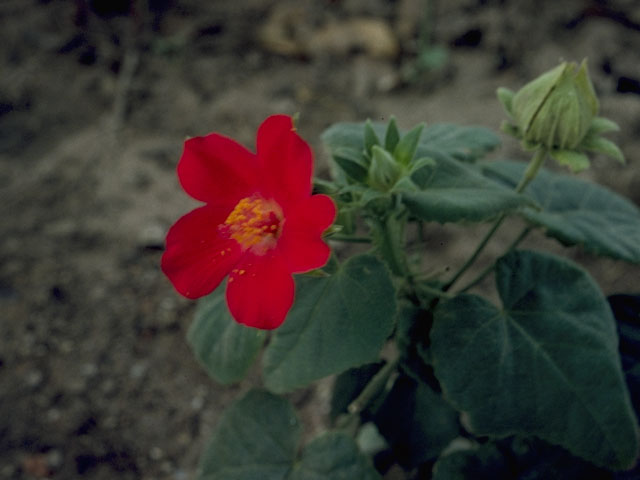 A leafy-stemmed perennial,
growing1-3 ft. depending on moisture. Prolific, red, 2-3 in. solitary flowers
occur at branch tips. The leaves are silvery and heart-shaped.
A leafy-stemmed perennial,
growing1-3 ft. depending on moisture. Prolific, red, 2-3 in. solitary flowers
occur at branch tips. The leaves are silvery and heart-shaped.
Flowers during the hottest part of
the season when other plants are not showy. This plant is everblooming if there
is no frost.
23) Hibiscus moscheutos ( crimsoneyed rosemallow)
24) Hibiscus mutabilis ( Dixie
rosemallow)
 Hibiscus mutabilis, also known as the Confederate rose or the
cotton rosemallow, is a plant noted for its flowers.
Leaves and flowers of H. mutabilis
are emollient and cooling, and are used to treat swellings and skin infections
(Dasuki, 2001). Mucilage from flowers and leaves is used by midwives to
facilitate delivery during labour. Confederate roses tend to be shrubby or treelike in Zones 9 and 10,
though it behaves more like a perennial further north. Flowers can be double or
single and are 4 to 6 inches in diameter; they open white or pink, and change
to deep red by evening. The 'Rubra' variety has red flowers. Single blooming
flowers are generally cup-shaped. Bloom season usually lasts from summer
through fall. Propagation by cuttings root easiest in early spring, but
cuttings can be taken at almost any time. When it does not freeze, the
Confederate rose can reach heights of 15 to 18 feet with a woody trunk;
however, a much bushier, 5 or 6 feet plant is more typical and provides more
flowering. These plants have a very fast growth rate. The Confederate rose was
at one time very common in the area of the Confederate States of America, which
is how its common name was derived. It grows well in full sun or partial shade,
and prefers rich, well-drained soil. Flowers are white in the morning, turning
pink during noon and red in the evening of the same day. Under laboratory
conditions, colour change of petals was slower than that of flowers under outdoor
conditions (Wong et al., 2009). Temperature may be an important factor
affecting the rate of colour change as white flowers kept in the refrigerator
remain white until they are taken out to warm, whereupon they slowly turn pink
(Ng, 2006).
Hibiscus mutabilis, also known as the Confederate rose or the
cotton rosemallow, is a plant noted for its flowers.
Leaves and flowers of H. mutabilis
are emollient and cooling, and are used to treat swellings and skin infections
(Dasuki, 2001). Mucilage from flowers and leaves is used by midwives to
facilitate delivery during labour. Confederate roses tend to be shrubby or treelike in Zones 9 and 10,
though it behaves more like a perennial further north. Flowers can be double or
single and are 4 to 6 inches in diameter; they open white or pink, and change
to deep red by evening. The 'Rubra' variety has red flowers. Single blooming
flowers are generally cup-shaped. Bloom season usually lasts from summer
through fall. Propagation by cuttings root easiest in early spring, but
cuttings can be taken at almost any time. When it does not freeze, the
Confederate rose can reach heights of 15 to 18 feet with a woody trunk;
however, a much bushier, 5 or 6 feet plant is more typical and provides more
flowering. These plants have a very fast growth rate. The Confederate rose was
at one time very common in the area of the Confederate States of America, which
is how its common name was derived. It grows well in full sun or partial shade,
and prefers rich, well-drained soil. Flowers are white in the morning, turning
pink during noon and red in the evening of the same day. Under laboratory
conditions, colour change of petals was slower than that of flowers under outdoor
conditions (Wong et al., 2009). Temperature may be an important factor
affecting the rate of colour change as white flowers kept in the refrigerator
remain white until they are taken out to warm, whereupon they slowly turn pink
(Ng, 2006).
The
red flowers remain on plants for several days before they abort (Wong et al.,
2009). Weight of a single detached flower was 15.6 g when white, 12.7 g when
pink and 11.0 g when red. Anthocyanin content of red flowers was 3 times that
of pink flowers and 8 times that of white flowers. There was a significant
increase in phenolic content with colour change. Overall ranking of AOP of H.
mutabilis flowers was red > pink > white.
Subramanian
and Nair (1970) postulated that anthocyanins in pink and red flowers of H. mutabilis
are synthesized independently since there is no reduction in phenolic content.
However, Lowry (1976) suggested that anthocyanins are formed through direct
conversion from flavonols as they have structural similarities.
In
ancient China, the flowers are believed to resemble beautiful ladies.A Chinese
proverb runs: "Cotton rosemallow out of the Water"(出水芙蓉), meaning a young lady of appreciated beauty.
Certain number of historical painting depicting beautiful young women are also
titled as such by their respective painters.
25)
Seaside mahoe is native to coastal
areas
of Bermuda, southern Florida, the
Bahamas, the
Greater and Lesser Antilles, and
from Mexico
through Brazil on the Atlantic
Coast and in Pacific
coastal areas from Mexico to
PeruSeaside mahoe is also
known as sea hibiscus and rope
mangrove in
English, emajagua and majagua in
Spanish, and
mahoe doux, mahaut, and bois flot
in French
(Howard 1989, Liogier 1994). It is
a large shrub or
occasionally a small tree. The
species normally
grows in tangled thickets formed by
stems that sag
until they touch the ground and
form roots.
Simultaneously, sprouts arise from
the horizontal
stems and grow upward until they in
turn become
prostrate. Occasionally, especially
on dry ground,
open-grown individuals grow in a
tree-like habit.
Adult plants have an aggressive
lateral root system
with abundant fine roots. The bark
of the limbs
and trunks is gray and smooth, but
can become
furrowed and scaly in old stems.
The leaves are
nearly round (10 to 15 cm in
diameter) except for a
deeply cordate base and a pointed
tip. The petioles
are long (6 to 9 cm). Seaside mahoe
produces large
yellow flowers that change to
orange or red as they
age. Soon after, 2-cm long, hairy,
cone-shaped
capsules develop, and upon drying,
split open along five lines to release their seeds. —The fibrous inner bark was
formerly
used to make ropes, cords, fish
nets, floats, cloth,
and mats. It is still used for
emergency ties and
lashings. The wood is used for fuel
in
underdeveloped areas (National
Academy of
Sciences 1983). The flowers make a
colorful and
tasty addition to salads and can be
cooked as a
vegetable (Workman 1980). The young
leaves,
bark, and roots were reportedly
used for food
during famines in former times
(Little and
Wadsworth 1964). Bees make honey
from the
nectar. The plant is used as an
ornamental and to
stabilize stream banks (Workman 1980).
26)
 Primarily recommended for natural
landscapes and habitat restorations. Also wildflower gardens in the Florida
Keys.
Primarily recommended for natural
landscapes and habitat restorations. Also wildflower gardens in the Florida
Keys.
Availability:
Grown by enthusiasts.
Description:
Medium to large herbaceous wildflower,
rarely woody at the base.
Dimensions:
About 1-4 feet in height. Usually
taller than broad or forming small masses about as broad as tall.
Growth Rate:
Moderate.
Range:
Monroe and Miami-Dade counties;
West Indies, Mexico and Guatemala. Rare in the Monroe County Keys, where mostly
restricted to coastal rock barrens. On the mainland, known only from Long Pine
Key in Everglades National Park in Miami-Dade County and the Loop Road area of
Big Cypress National Preserve in Monroe County.
Habitats:
Rockland hammock edges and
thickets.
27) Hibiscus radiatus (monarch
rosemallow)
 Malvaceae
Group: Dicot
Substrate: Terrestrial
Habit: Herb
Perennation: Perennial
SOUTH FLORIDA Occurrence: Present
SOUTH FLORIDA Native Status: Not
Native, Naturalized
SOUTH FLORIDA Cultivated Status:
Not Cultivated
28)Hibiscus rosa-sinensis L. –
shoeblackplant
29) Hibiscus sabdariffa ( roselle)
The flowers are 8–10 cm (3–4 in) in
diameter, white to pale yellow with a dark red spot at the base of each petal,
and have a stout fleshy calyx at the base, 1–2 cm (0.39–0.79 in) wide,
enlarging to 3–3.5 cm (1.2–1.4 in), fleshy and bright red as the fruit matures.
It takes about six months to mature. The roselle is known as the rosella or
rosella fruit in Australia. It is also known as 'Belchanda' among Nepalese,
Tengamora among Assamese and "mwitha" among Bodo tribals in Assam, চুকর
Chukor in Bengali, Gongura in Telugu, Pundi in Kannada, Ambadi in Marathi,
LalChatni or Kutrum in Mithila] Mathipuli in Kerala, chin baung in Burma, กระเจี๊ยบแดง
KraJiabDaeng in Thailand, ສົ້ມ ພໍດີ
som phor dee in Lao PDR, bissap in Senegal, Guinea Bissau, Mali, Burkina Faso,
Ghana, Benin and Niger, the Congo and France, dah or dah bleni in other parts
of Mali, wonjo in the Gambia, zobo in western Nigeria (the Yorubas in Nigeria
call the white variety Isapa (pronounced Ishapa)), Zoborodo in Northern
Nigeria, Chaye-Torosh in Iran, karkade (كركديه; Arabic pronunciation:
[ˈkarkade])[dubious – discuss] in Egypt, Saudi Arabia, and Sudan, omutete in
Namibia, sorrel in the Caribbean and in Latin America, Flor de Jamaica in
Mexico, Saril in Panama, grosella in Paraguay and vinagreira, caruru-azedo or
quiabo-roxo in Brazil. Rosela in Indonesia, asam belanda[1] in Malaysia. In
Chinese it is 洛神花
(Luo Shen Hua) . In Zambia the plant is called lumanda in ciBemba, katolo in
kiKaonde, or wusi in chiLunda.
The plant is considered to have antihypertensive properties. In some places, the plant is
primarily cultivated for the production of bast fibre from
the stem of the plant. The fibre may be used as a substitute for jute in makingburlap.[2] Hibiscus, specifically Roselle, has been used in
folk medicine as a diuretic, mild laxative, and treatment for cardiac and nerve
diseases and cancer.[3]
The red calyces of the plant are increasingly exported to America and Europe, where they are used as food colourings. Germany is the main importer. It can also be found
in markets (as flowers or syrup)
in some places such as France, where there are Senegalese immigrant communities. The green leaves are used like a spicy version of spinach. They give flavour to the Senegalese fish
and rice dish thiéboudieune.
Proper records are not kept, but the Senegalese government estimates national
production and consumption at 700 t (770 short tons) per year. Also
in Burma their green leaves are the main ingredient
in making chin baung khaw curry. in East Africa, the calyx infusion, called
"Sudan tea", is taken to relieve coughs. Roselle juice, with salt,
pepper, asafoetida and molasses, is taken as a remedy for biliousness.
The heated leaves are applied to cracks in the feet and on boils
and ulcers to speed maturation. A lotion made from leaves is used on sores and
wounds. The seeds are said to be diuretic and tonic in action and the
brownish-yellow seed oil is claimed to heal sores on camels. In India, a decoction of the seeds is given to relieve dysuria, strangury and
mild cases of dyspepsia. Brazilians attribute stomachic,
emollient and resolutive properties to the bitter roots.
30) Hibiscus schizopetalus (Dyer) Hook(fringed
rosemallow)
Synonym: Hibiscus rosa-sinensis var. schizopetalus
Common Names: Coral Hibiscus, Fringed Rosemallow,
Japanese Lantern, Chinese Lantern, Pagoda Flower, Skeleton Hibiscus, Fringed
Hibiscus
Plant Characteristics
Duration: Perennial, Evergreen
Growth Habit: Shrub, Subshrub, Herb/Forb
Hawaii Native Status: Cultivated. This ornamental
garden plant is native to Kenya, Tanzania, and Mozambique.
Flower Color: Red with pink streaks, Coral pink
Flowering Season: Year-round but sporadic
Height: Up to 13 feet (4 m) tall, but usually less
Description: The flowers are dangling and have 5
fringed, deeply pinnately-lobed, recurved petals and a pink, pendent, curved,
up to 4 inch (10 cm) long central staminal column with a 5-branched style and
anthers near the tip of the column. The flowers are followed by oblong,
cylindrical seed capsules. The leaves have a short petiole and are green,
hairless, alternate, sharply toothed, unlobed, and elliptic to oblong in shape.
The plants are narrow and have slender, arching, woody stems.
Here in Hawaii, Coral Hibiscus grows in moist, sunny
gardens.
31)
_'Blushing_Bride'.jpg) Hibiscus syriacus is a large shrub or small tree,
attaining a height of 4 meters or more, that is native to Asia. This species is
naturalized in scattered locations across Arkansas and over much of the eastern
US. Hibiscus syriacus is capable of self-pollination and subsequent
self-ertilization, and juvenile plants are often seen in the vicinity of a
single, reproductive age plant. Plants prefer exposure to several hours of
direct sun per day, however, will survive and grow under conditions of increased
levels of shade.
Hibiscus syriacus is a large shrub or small tree,
attaining a height of 4 meters or more, that is native to Asia. This species is
naturalized in scattered locations across Arkansas and over much of the eastern
US. Hibiscus syriacus is capable of self-pollination and subsequent
self-ertilization, and juvenile plants are often seen in the vicinity of a
single, reproductive age plant. Plants prefer exposure to several hours of
direct sun per day, however, will survive and grow under conditions of increased
levels of shade.
Numerous flower color and flower morphology forms
occur, including some forms with "double" roselike flowers (these
flowers have more than the usual five petals). Flower color can range from red
to lilac, purple, or bluish, to completely white. The dark red pigmentation on
the proximal portions of the petals is typical.
32) Hibiscus tiliaceus ( sea hibiscus)
 Hibiscus tiliaceus is a species of flowering tree in
the mallow family, Malvaceae, that is native to the Old World tropics.[3]
Common names include Sea Hibiscus, Beach Hibiscus, Coastal (or Coast) Hibiscus,
Coastal (or Coast) Cottonwood, Green Cottonwood, Native Hibiscus, Native
Rosella, Cottonwood Hibiscus, Kurrajong, Sea Rosemallow, Norfolk Hibiscus, Hau
(Hawaiian), and Purau (Tahitian). The specific epithet, "tiliaceus",
refers to its resemblance to the related Tilia species. H. tiliaceus is a
common coastal plant in Eastern and Northern Australia, Oceania, Maldives and
Southeast Asia. It has become naturalized in parts of the New World, such as
Florida, Puerto Rico, and the Virgin Islands. It is uncertain if the species is
native to Hawaii, as it may have been introduced by the Polynesians.H.
tiliaceus can be found at elevations from sea level to 800 m (2,600 ft) in
areas that receive 900–2,500 mm (35–98 in) of annual rainfall. It is commonly
found growing on beaches, by rivers and in mangrove swamps. Sea Hibiscus is
well adapted to grow in coastal environment in that it tolerates salt and
waterlogging and can grow in quartz sand, coral sand, marl, limestone,and
crushed basalt. It grows best in slightly acidic to alkaline soils (pH of
5-8.5).The plant lends its name to a coastal community in Cotton Tree,
Queensland, Australia.
Hibiscus tiliaceus is a species of flowering tree in
the mallow family, Malvaceae, that is native to the Old World tropics.[3]
Common names include Sea Hibiscus, Beach Hibiscus, Coastal (or Coast) Hibiscus,
Coastal (or Coast) Cottonwood, Green Cottonwood, Native Hibiscus, Native
Rosella, Cottonwood Hibiscus, Kurrajong, Sea Rosemallow, Norfolk Hibiscus, Hau
(Hawaiian), and Purau (Tahitian). The specific epithet, "tiliaceus",
refers to its resemblance to the related Tilia species. H. tiliaceus is a
common coastal plant in Eastern and Northern Australia, Oceania, Maldives and
Southeast Asia. It has become naturalized in parts of the New World, such as
Florida, Puerto Rico, and the Virgin Islands. It is uncertain if the species is
native to Hawaii, as it may have been introduced by the Polynesians.H.
tiliaceus can be found at elevations from sea level to 800 m (2,600 ft) in
areas that receive 900–2,500 mm (35–98 in) of annual rainfall. It is commonly
found growing on beaches, by rivers and in mangrove swamps. Sea Hibiscus is
well adapted to grow in coastal environment in that it tolerates salt and
waterlogging and can grow in quartz sand, coral sand, marl, limestone,and
crushed basalt. It grows best in slightly acidic to alkaline soils (pH of
5-8.5).The plant lends its name to a coastal community in Cotton Tree,
Queensland, Australia.
The wood of
H. tiliaceus has a specific gravity of 0.6. It has been used in a variety of
applications, such as seacraft construction, firewood, and wood carvings. Its
tough bark can be made into durable rope and used for sealing cracks in boats.
The bark and roots may be boiled to make a cooling tea to cool fevers, and its
young leafy shoots may be eaten as vegetables. Native Hawaiians used the wood
to make ʻiako (spars) for waʻa (outrigger canoes), mouo (fishing net floats),
and ʻau koʻi (adze handles). Kaula ʻilihau (cordage) was made from the bast
fibers. Hau would be used to make ʻama (canoe floats) if wiliwili (Erythrina sandwicensis)
was unavailable.
H. tiliaceus, is widely used in Asian countries as a
subject for the art of bonsai, especially Taiwan. The finest specimens are
taken from Kenting National Park. Lending itself to free grafting, the leaf
size is reduced fairly quickly.
33) Hibiscus trionum (flower of an hour)
 Hibiscus trionum, commonly called
Flower-of-an-Hour,[2] bladder hibiscus, bladder ketmia,bladder weed,
flower-of-an-hour, flower-of-the-hour, modesty, puarangi, shoofly, and venice
mallow,[2] is an annual plant that is native to the east of the Mediterranean
in the Levant, It has spread throughout southern Europe both as a weed and cultivated
as a garden plant. It has been introduced to the United States as an ornamental
where it has become naturalized as a weed of cropland and vacant land.
Hibiscus trionum, commonly called
Flower-of-an-Hour,[2] bladder hibiscus, bladder ketmia,bladder weed,
flower-of-an-hour, flower-of-the-hour, modesty, puarangi, shoofly, and venice
mallow,[2] is an annual plant that is native to the east of the Mediterranean
in the Levant, It has spread throughout southern Europe both as a weed and cultivated
as a garden plant. It has been introduced to the United States as an ornamental
where it has become naturalized as a weed of cropland and vacant land.
The plant grows to a height of 20-50 cm, sometimes
as much as 80 cm, and has white or yellow flowers with a purple centre.

No comments:
Post a Comment